
Die Application Gallery bietet COMSOL Multiphysics® Tutorial- und Demo-App-Dateien, die für die Bereiche Elektromagnetik, Strukturmechanik, Akustik, Strömung, Wärmetransport und Chemie relevant sind. Sie können diese Beispiele als Ausgangspunkt für Ihre eigene Simulationsarbeit verwenden, indem Sie das Tutorial-Modell oder die Demo-App-Datei und die dazugehörigen Anleitungen herunterladen.
Suchen Sie über die Schnellsuche nach Tutorials und Apps, die für Ihr Fachgebiet relevant sind. Beachten Sie, dass viele der hier vorgestellten Beispiele auch über die Application Libraries zugänglich sind, die in die COMSOL Multiphysics® Software integriert und über das Menü File verfügbar sind.

Dieses Tutorial zeigt die Analyse eines Fahrzeuginnenraums, um die Leistung eines Soundsystems im niedrigen bis mittleren Frequenzbereich zu untersuchen. Die Fahrzeugkabine ist eine typische Limousine, d.h. das Innere eines Familienautos mit festem Verdeck. Das Modell untersucht den ... Mehr lesen

An electrodynamic ion funnel provides an efficient means of transferring ions from regions of high pressure to high vacuum. The ion funnel can couple devices which generally operate at pressures of different orders of magnitude, such as ion mobility spectrometers and mass spectrometers, ... Mehr lesen

This three-phase induction motor model is used to compare with Testing Electromagnetic Analysis Method (TEAM) workshop problem 30. The Magnetic Fields physics interface is used to model the motor in the frequency domain at 60 Hz. The Velocity (Lorentz Term) feature is used to model the ... Mehr lesen

The contact impedance boundary condition is meant to approximate a thin layer of material that impedes the flow of current normal to the boundary, but does not introduce any additional conduction path tangential to the boundary. This example compares the contact impedance boundary ... Mehr lesen

Bei der Modellierung des Transports durch Diffusion oder Leitung in dünnen Schichten stößt man häufig auf große Unterschiede in den Abmessungen der verschiedenen Gebiete in einem Modell. Handelt es sich bei der modellierten Struktur um eine so genannte Sandwichstruktur, können wir die ... Mehr lesen

Diese App demonstriert die Verwendung eines Ersatzmodells zur Vorhersage der Zellspannung, der Leerlaufspannung und des Innenwiderstands einer NMC111/Graphit-Batteriezelle, die einem Batterietestzyklus unterzogen wird. Das Ersatzmodell, ein Deep Neural Network, wurde an einen Teil der ... Mehr lesen
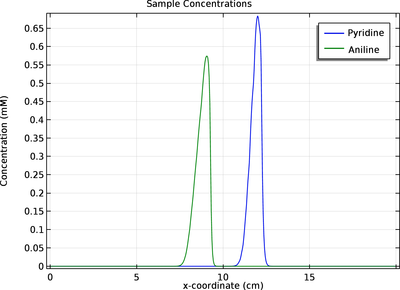
Zone electrophoresis (ZE) is an electrophoretic separation technique typically used for analyzing proteins, nucleic acids, and biopolymers. During the process, different species in a sample are transported in a continuous electrolyte buffer system, subject to a potential gradient. Due to ... Mehr lesen

Diese App demonstriert die Verwendung einer Ersatzmodellfunktion zur Vorhersage der Ratenfähigkeit einer NMC111/Graphit-Akkuzelle. Die Ratenfähigkeit wird in einem Ragone-Diagramm dargestellt. Die Ersatzfunktion, ein Deep Neural Network, wurde an eine Teilmenge der möglichen ... Mehr lesen

This example of a simple axisymmetric condenser microphone includes all the relevant physics and determines the microphone sensitivity as well as microphone capacitance for the specific simplified microphone geometry and material parameters. It solves a fully coupled multiphysics model ... Mehr lesen
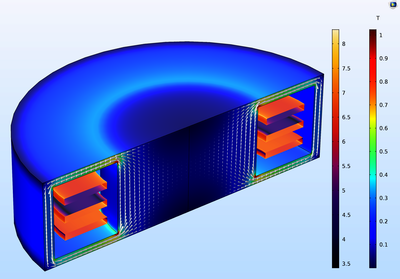
Inductive devices experience capacitative coupling between conductors at high frequencies. Modeling this phenomenon requires that you describe electric fields that have components both parallel with and perpendicular to the wire. This consideration might lead to the conclusion that a 3D ... Mehr lesen


