
Die Application Gallery bietet COMSOL Multiphysics® Tutorial- und Demo-App-Dateien, die für die Bereiche Elektromagnetik, Strukturmechanik, Akustik, Strömung, Wärmetransport und Chemie relevant sind. Sie können diese Beispiele als Ausgangspunkt für Ihre eigene Simulationsarbeit verwenden, indem Sie das Tutorial-Modell oder die Demo-App-Datei und die dazugehörigen Anleitungen herunterladen.
Suchen Sie über die Schnellsuche nach Tutorials und Apps, die für Ihr Fachgebiet relevant sind. Beachten Sie, dass viele der hier vorgestellten Beispiele auch über die Application Libraries zugänglich sind, die in die COMSOL Multiphysics® Software integriert und über das Menü File verfügbar sind.

Dieses Tutorial-Modell veranschaulicht, wie die Akustik im Fahrzeuginnenraum mithilfe eines hybriden FEM-Raytracing-Ansatzes modelliert werden kann. Das konkrete Beispiel ist ein Hochtöner, der sich im Armaturenbrett des Fahrzeugs in der Nähe der Windschutzscheibe befindet. Ein FEM ... Mehr lesen
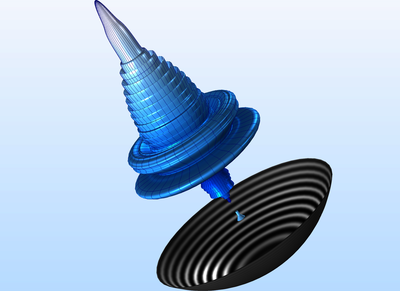
A large reflector can be modeled easily with the 2D axisymmetric formulation. In this model, the radius of the reflector is greater than 20 wavelengths and the reflector is illuminated by an axial feed circular horn antenna. The simulated far-field shows a high-gain sharp beam pattern Mehr lesen

In these tutorial series, we demonstrate how to use the Offset Faces and Transform Faces operations as a way to reparameterize existing holes in a bracket geometry imported from a STEP file. The mass of the bracket is minimized with limits for both the lowest natural frequency, and for ... Mehr lesen
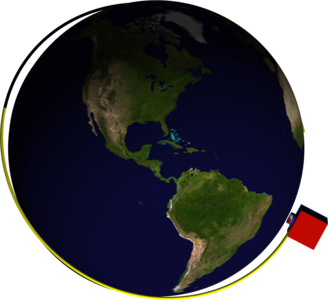
This model is an introduction to defining and verifying a satellite orbit, and computing the solar, albedo, and Earth infrared thermal loads. A 1U CubeSat is in a circular orbit at 400km altitude, inclination of 50°, and longitude of ascending node of 0°. The satellite is rotating slowly ... Mehr lesen
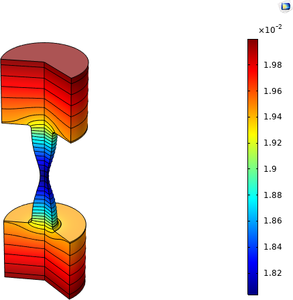
This model demonstrates the "butterfly" filling mechanism for copper electrodeposition in a Through-Hole (TH) via exposed to an electrolyte containing halide-suppressor additives. The Tertiary Current Distribution, Nernst Planck interface in combination with Deformed Geometry is used ... Mehr lesen

Breaker and disconnector devices are widely used in AC substations in power systems.In this model, the Electrostatics Interface is used to simulate the electric potential and electric field in a 110kV 3-phase high-voltage switchgear operating at 50 Hz. A surrogate model is also trained ... Mehr lesen

This example demonstrates the usage of current terminal to compute the resistive heating of a busbar. Mehr lesen

In the semiconductor industry, rapid thermal annealing (RTA) is a semiconductor process step used for the activation of dopants and the interfacial reaction of metal contacts. In principle, the operation involves rapid heating of a wafer from ambient to approximately 1000–1500 K. As soon ... Mehr lesen
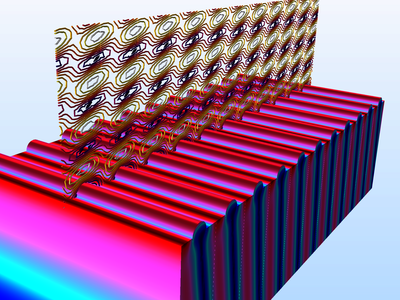
Surface plasmon-based circuits are being used in applications such as plasmonic chips, light generation, and nanolithography. The Plasmonic Wire Grating Analyzer application computes the coefficients of refraction, specular reflection, and first-order diffraction as functions of the ... Mehr lesen

A model built with the RF Module can be connected to an electrical circuit equivalent, if there is some structure outside of the model space that you wish to approximate as a circuit equivalent. In this model, the 3D model of a coaxial cable is connected to a voltage source, in series ... Mehr lesen


