
Die Application Gallery bietet COMSOL Multiphysics® Tutorial- und Demo-App-Dateien, die für die Bereiche Elektromagnetik, Strukturmechanik, Akustik, Strömung, Wärmetransport und Chemie relevant sind. Sie können diese Beispiele als Ausgangspunkt für Ihre eigene Simulationsarbeit verwenden, indem Sie das Tutorial-Modell oder die Demo-App-Datei und die dazugehörigen Anleitungen herunterladen.
Suchen Sie über die Schnellsuche nach Tutorials und Apps, die für Ihr Fachgebiet relevant sind. Beachten Sie, dass viele der hier vorgestellten Beispiele auch über die Application Libraries zugänglich sind, die in die COMSOL Multiphysics® Software integriert und über das Menü File verfügbar sind.
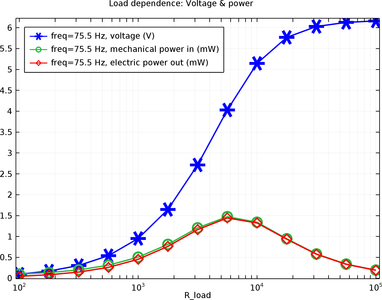
Dieses Modell zeigt, wie ein einfacher piezoelektrischer Nanogenerator auf Basis eines Auslegers analysiert werden kann. Der Nanogenerator wird mit einer sinusförmigen Beschleunigung beaufschlagt, und die Ausgangsleistung wird als Funktion der Frequenz, der Lastimpedanz und der ... Mehr lesen

This example shows how to model a deep excavation. The main application area of this type of modeling is in civil engineering. In this case, the in situ lateral pressure acting on the retaining wall during the soil excavation is modeled with boundary loads. The soil assumes Drucker ... Mehr lesen

Dieses Tutorial-Modell zeigt einen virtuellen Testaufbau eines Konferenzlautsprechers. Das Lautsprechersystem besteht aus einem Lautsprecher sowie drei Mikrofonen. Das Modell veranschaulicht die Schallabstrahlung des Lautsprechers, die Rückkopplung sowie die Fähigkeit des Systems, ... Mehr lesen

A Biconical antenna is a type of wideband antenna with omni-directional radiation pattern in the H-plane similar to a dipole antenna. A coaxial feed is connected to the radiators using two 90 degree bent arms. The model shows that the biconical antenna works well in applications ... Mehr lesen

This example shows how to set up multiple sandwiched thin layers with different thermal conductivities in two different ways. First, the composite is modeled as a 3D object. In the second approach, the thin domains are modeled with thermal resistors in the Lumped Thermal System ... Mehr lesen
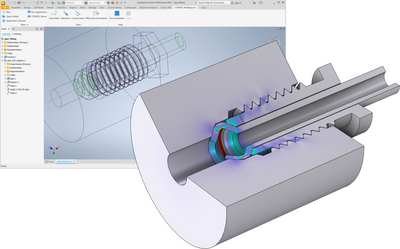
This tutorial model shows the setup of a 2D axisymmetric stress analysis, through contact, of a 3D threaded pipe fitting. The example involves synchronizing the 3D Inventor® geometry and selections, which specify the faces in contact, with the 2D geometry in COMSOL Multiphysics ... Mehr lesen
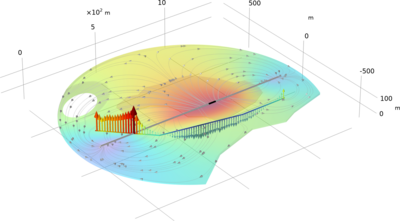
Light rail transit (LRT) systems often utilize DC power for train propulsion. In these systems the potential gradients in the rails may induce stray currents, which corrode adjacent metallic structures. In this example, the Cathodic Protection interface, using Edge Electrode nodes, is ... Mehr lesen

Sensitivity analysis is an efficient way of computing the gradient of an objective function with respect to many control variables. This example uses the pitch and yaw in the top of a truss tower as objective functions. It shows how to compute the sensitivity of these angles with respect ... Mehr lesen

Power inductors are a central part of many low-frequency power applications. They are, for example, used in the switched power supply for the motherboard and all other components in a computer. Computer simulations are necessary in the design of such inductors. This model calculates the ... Mehr lesen

The Shallow Water equations are frequently used for modeling both oceanographic and atmospheric fluid flow. Models of such systems lead to the prediction of areas eventually affected by pollution, coast erosion and polar ice-cap melting. Comprehensive modeling of such phenomena using ... Mehr lesen


