
Die Application Gallery bietet COMSOL Multiphysics® Tutorial- und Demo-App-Dateien, die für die Bereiche Elektromagnetik, Strukturmechanik, Akustik, Strömung, Wärmetransport und Chemie relevant sind. Sie können diese Beispiele als Ausgangspunkt für Ihre eigene Simulationsarbeit verwenden, indem Sie das Tutorial-Modell oder die Demo-App-Datei und die dazugehörigen Anleitungen herunterladen.
Suchen Sie über die Schnellsuche nach Tutorials und Apps, die für Ihr Fachgebiet relevant sind. Beachten Sie, dass viele der hier vorgestellten Beispiele auch über die Application Libraries zugänglich sind, die in die COMSOL Multiphysics® Software integriert und über das Menü File verfügbar sind.

The catenary is the geometrical shape that corresponds to the curve followed by an idealized chain or cable supported at both ends and hanging under its own weight. The viscous catenary problem describes the motion of a cylinder of highly viscous fluid, supported at its ends as it flows ... Mehr lesen
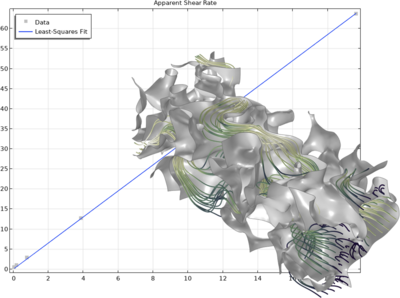
Non-Newtonian fluids have complex flow characteristics that vary with shear rate, making their behavior in porous materials difficult to predict. Pore scale modeling captures these flow patterns at a microscopic level, helping derive properties for macroscale use. This model ... Mehr lesen

In this time-dependent model, a silica block of glass, coated with a thin copper layer is subjected to a heat flux. Copper is a highly conductive material, while the silica glass is of poor thermal conductivity, which sets up an highly-varied temperature differential. The model must ... Mehr lesen
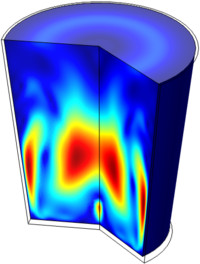
Dieses Modell behandelt die freie Konvektion und den Wärmetransport eines Glases mit kaltem Wasser, das sich auf Raumtemperatur erwärmt. Zu Beginn haben das Glas und das Wasser eine Temperatur von 5 °C und werden dann auf einen Tisch in einem Raum mit 25 °C gestellt. Die nicht-isotherme ... Mehr lesen
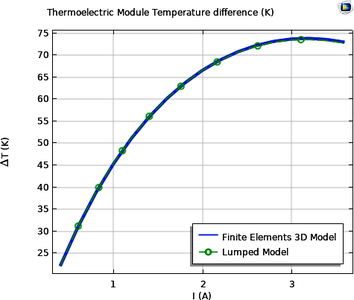
Thermoelectric coolers are widely used for electronics cooling in various application areas, ranging from consumer products to spacecraft design. The thermoelectric modules are a common application of thermoelectricity in cooling engineering. They consist of several thermoelectric legs ... Mehr lesen

This model represents a stove in a living room. A radiation study is performed with the Surface-to-Surface Radiation physics interface. It shows the intensity of the stove radiation received on different surfaces of the room. Mehr lesen
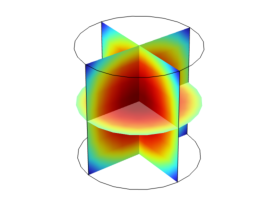
These models use the Discrete Ordinates method (DOM) and P1 approximation to solve a 3D radiative transfer problem in an emitting, absorbing, and linear-anisotropic scattering finite cylindrical medium. Using the S6 quadrature of DOM leads to accurate results, which are needed in ... Mehr lesen

The contact angle of a two-fluid interface with a solid surface is determined by the balance of the forces at the contact point. In electrowetting the balance of forces at the contact point is modified by the application of a voltage between a conducting fluid and the solid surface. In ... Mehr lesen

This model computes the transmission probability through an s-bend geometry using both the angular coefficient method available in the Free Molecular Flow interface and a Monte Carlo method using the Mathematical Particle Tracing interface. The computed transmission probability by the ... Mehr lesen

This example is a variant of the Composite Thermal Barrier tutorial and shows how to set up multiple sandwiched thin layers with different thermal conductivities in two different ways. First, the composite is modeled as a 3D object. In the second approach the Lumped Thermal System ... Mehr lesen


