
Die Application Gallery bietet COMSOL Multiphysics® Tutorial- und Demo-App-Dateien, die für die Bereiche Elektromagnetik, Strukturmechanik, Akustik, Strömung, Wärmetransport und Chemie relevant sind. Sie können diese Beispiele als Ausgangspunkt für Ihre eigene Simulationsarbeit verwenden, indem Sie das Tutorial-Modell oder die Demo-App-Datei und die dazugehörigen Anleitungen herunterladen.
Suchen Sie über die Schnellsuche nach Tutorials und Apps, die für Ihr Fachgebiet relevant sind. Beachten Sie, dass viele der hier vorgestellten Beispiele auch über die Application Libraries zugänglich sind, die in die COMSOL Multiphysics® Software integriert und über das Menü File verfügbar sind.

This model shows how to compute an array of borehole heat exchangers (BHEs) for shallow geothermal energy production. The BHEs are simplified as line heat sinks with a uniform heat extraction rate. The array is embedded into a layered subsurface model with groundwater flow in one of the ... Mehr lesen
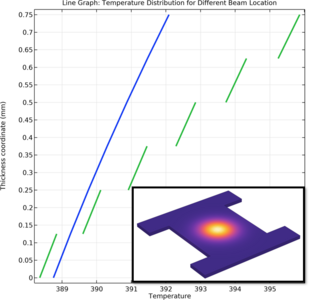
This example uses the thermal expansion of a laminated composite shell model to demonstrate the use of the feature Thermal Contact, Interface, applied on interfaces between layers in a laminated composite shell. The first study is computed neglecting this additional thermal resistance in ... Mehr lesen

This model computes the particle flux, number density and pressure on the surface of a plate that rotates in a highly directional molecular flow. The results obtained are compared with those from other, approximate, techniques for computing molecular flows. Mehr lesen

This model shows how to use the Metal Processing Module and the Optimization Module to calibrate parameters of a phase transformation model against TTT (Time Temperature Transformation) data. Mehr lesen

Reflow soldering is an important process in IC packaging. In reflow soldering, the solder materials are melted to create joints between electrical components and the PCBs for structural and electrical connections. This model demonstrates the process of attaching chips to a PCB by reflow ... Mehr lesen

You can use assembly meshing to reduce the number of mesh elements in your model, which is especially useful for conjugate heat transfer simulation in cases where the fluid domains can be handled with swept mesh. These models demonstrate how to use form assembly and discontinuous meshes ... Mehr lesen
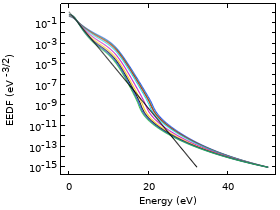
In this example, a hydrogen plasma reactor at moderate pressure is studied using a global model. The heavy species heat equation is included. In the first part of the study, a Maxwellian electron energy distribution function is used. In the second part, the global model is solved self ... Mehr lesen

This model presents a way to compute projected area using the Surface-to-Surface Radiation interface of the Heat Transfer Module. By computing illuminated area from a set of directions on a discretized sphere, it is possible to interpolate the projected area onto any angle of incidence. ... Mehr lesen
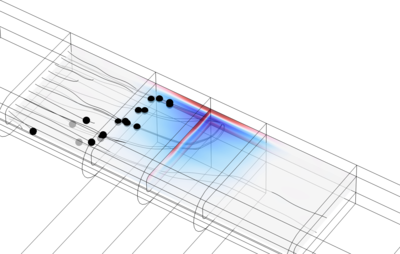
Ein 3D-Modell einer akustischen Falle in einer Glaskapillare mit einem Bias-Flow durch die Kapillare. Die Akustik wird durch ein oszillierendes elektrisches Potential über einen piezoelektrischen Wandler angeregt, das mechanische Schwingungen im Festkörper und ein akustisches Druckfeld ... Mehr lesen

This model demonstrates topology optimization of a 2D heat exchanger with laminar flow. The flow is pressure driven and the objective is to maximize the heat transfer. The density method is used with the (now) classical approach of a single design variable and two flow interfaces. ... Mehr lesen


